Friday, July 10, 2015

Diyarbakir (Amida), AD 502-503

AD 502-503
The second siege of Amida came almost 150 years later. That century and a half had largely been a peaceful one. The Persians seemed satisfied with the new territory gained after Julian's death and contented themselves with only interfering in Armenia. This new found peace was aided by a series of crises that affected the Persian empire. This time it was their turn to come under barbarian attack, and a series of monarchs were defeated by the Hephthalites who invaded the eastern regions of the empire from their territory in modern Afghanistan and Pakistan.

The most disastrous campaign was that of Peroz. Defeated in one encounter he was forced to leave his young son Kavad as hostage with the Hephthalite king. Unwilling to let this humiliation go he broke his oath and returned to Hephthalite territory where at Herat he was tricked into leading a cavalry charge across concealed pits and killed along with most of his army. His son Balash was able to piece together a new government in Ctesiphon, but this brought him into conflict with his remaining brothers. Kavad, who had been released by this point, fled to the Hephthalites and was able to convince them to support him in his efforts to take the throne from his brother. With their army backing him seizing his kingdom was easy. While Peroz had maintained favorable relations with the Romans, who had even supported him in his campaigns against the nomads reasoning that they did after all threaten both sides (the Huns were considered the kin of the Hephthalites), Kavad with his huge debts to the Hephthalites found himself strongly in need of funds but with little use for the minimal Roman support or peace. And their lands were a rich and very tempting way to rebuild his kingdom's wealth.

Thursday, July 9, 2015

Diyarbakir (Amida), AD 359

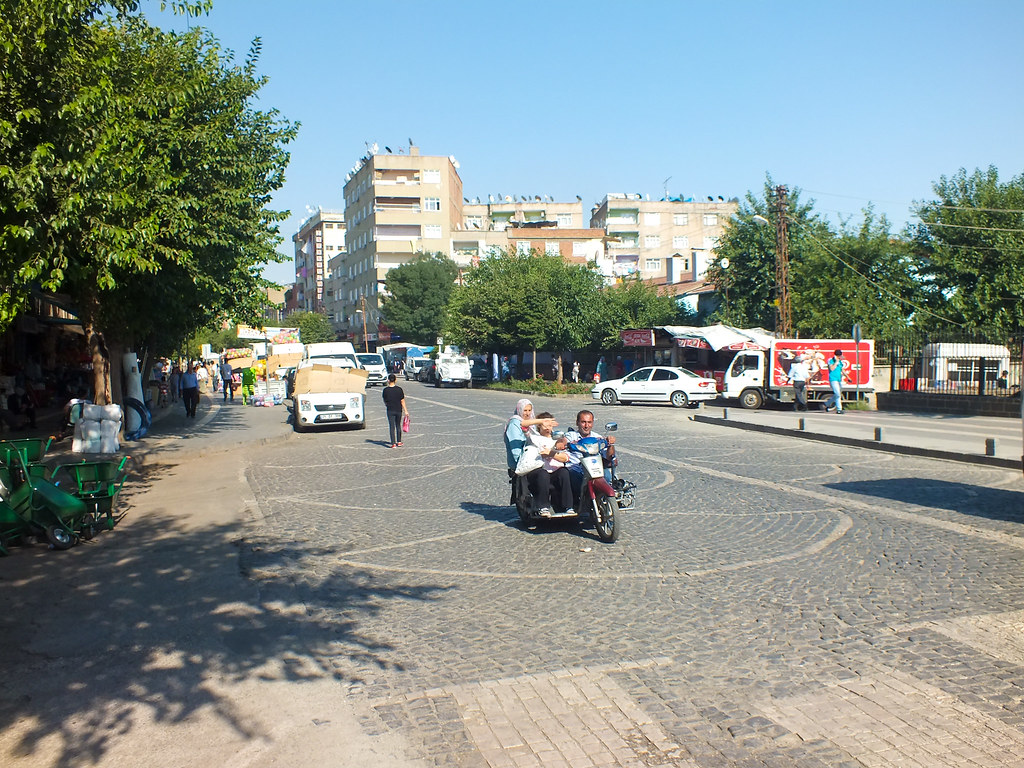
Diyarbakir is a bustling city in the southeastern part of Turkey. Located about 80 kilometers north of the Syrian border, it is the capital of Diyarbakir province and the unofficial capital of Turkish Kurdistan. As you might imagine that doesn't make it the safest place to be right now, although when I went the Kurdish PKK still had a truce with the Turkish government and Daesh had yet to execute any (proven) attacks on Turkish soil. I got in and out just in time too. Nine days after I left the city a Daesh suicide bomber killed 32 youth activists in Suruç (in Şanlıurfa province about 200 km to the west) and shortly after that the PKK murdered three policemen in Diyarbakir in revenge. Now the entire region seems poised to begin a new wave of violence as Turkey takes advantage of the chaos to their south to crack down on their Kurdish problem, all in the name of fighting extremism. Yay.

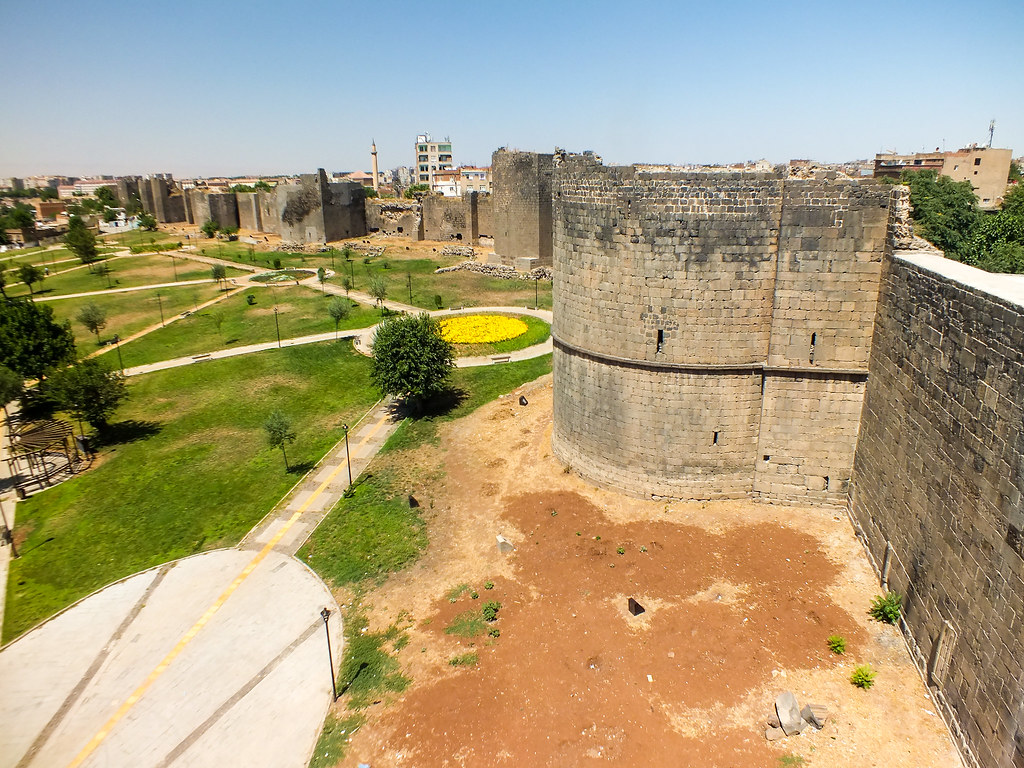
So what made Diyarbakir worth the risk? The old city of Diyarbakir contains a nearly complete set of circuit walls that have survived with few modifications from the late Roman period. More impressive considering this fact is the city's classical antecedents. Once upon a time it was the city of Amida (even today the city is often called Amed in Kurdish). The capital of the province of Mesopotamia, this city produced many important figures but is most famous for undergoing two well-recorded sieges during late antiquity. These sieges are so well recorded in fact that in conjunction with the surviving city walls it is possible to actually identify many of the features in them. For that reason what follows will be a description of the sieges themselves as illustrated by the surviving remains. Due to space constraints this section will only cover the first siege under Constantius and Shapur II while the second will cover the siege under Anastasius and Kavad.

Saturday, November 10, 2012

Lincoln (Roman)

I already have a page for Lincoln but since that time I only dealt with the medieval sections (ie: the cathedral and castle) while this time I saw the Roman bits I felt that they could be safely divided in two. After all, that trip was almost two years ago.

Tuesday, September 18, 2012

Hadrian's Wall, Part VIII (South of the Wall)

Hadrian's Wall wasn't just maintained by the forts on the wall. There were a large number of forts to the south keeping it supplied and ferrying troops where needed. The majority of these are not usually seen on a Wall trip since they are located several miles away from the path and need a full day trip to reach them. Some are ones I haven't been to but intend to before my time here is up. I could have listed most of these as separate trips and I visited several at the same time I walked the wall, but it made more sense to split the wall into wall forts, supply forts, and forts north of the wall. Some of these are linked to days on the wall since they are so close and the journey was the same. For example, we stayed the night in Corbridge yet it is listed separately here. So you can follow the links to see what else is around in that area and what we did for the rest of the day.

Thursday, September 13, 2012

Hadrian's Wall, Part III (Corbridge to Chesters)

Our third day on the wall went much more smoothly than our second. It wasn't nearly as hard (or rather it shouldn't have been) and we were mostly walking through towns along the road. We were quite drained from the previous day though, and our 'easy' trip became quite strenuous as we yet again arrived late to our stopping point. A key thing to remember when doing this section is that while Corbridge and Hexham may be only a couple miles south of the wall those miles are straight uphill. It isn't as easy as it looks. Had we known then what we do now we'd probably have just grabbed the AD123 bus from Hexham up to Wall or Corbridge and then continued from there.

Wednesday, September 12, 2012

Hadrian's Wall, Part II (Newcastle to Corbridge)

 
 Intro
Having spent our first day wandering around Newcastle and getting the train everywhere we finally set off on the actual hike. Our plan today was to get to Corbridge where we had a bed & breakfast reserved for the night. I looked it up on Google Maps and it said that the entire journey would cover about fifteen miles, a long but not impossible stretch. Since there was basically nothing to see for this part of the journey (and certainly no stretches of wall) this didn't seem like a bad idea at the time. Do the serious walking on the days when there were few places to stop at and save the slow days for areas where there was a lot to see. There were only two problems. First, the distance calculation was based on road miles in a direct line to our destination. Google Maps doesn't include walking paths in its directions. I figured that the actual distance would be less than the road miles since the path could cut corners which roads would have to circle around. Boy was I wrong. The trail heads along the river for a while, but then it goes sharply north up through Heddon and then keeps going along a north-westerly direction whereas Corbridge is right on the river about two miles south of the wall. So our strenuous fifteen mile hike turned into a draining twenty mile slog that took up the entirety of the day. Second, I didn't factor in the terrain. Google Maps doesn't show the terrain and while Google Earth does it's very hard to get an idea from it of just how steep it really is. The hills weren't too bad (at least today) but once the trail goes off road all time calculations get thrown off. I'm used to hiking wilderness trails or along roads, not cutting across fields and climbing over fences. Progress is slow and painful, and it doesn't help when you're tired from having walked ten miles already and then up a steep hill. By the time we arrived at Corbridge at about 9 PM we were too tired to move.

Tuesday, September 11, 2012

Hadrian's Wall, Part I (South Shields to Newcastle)

 Because this is such a large area this section will be split into nine parts, one for each of the seven days of the trip plus an extra two for the miscellaneous forts surrounding the wall. The majority of this walk (from Newcastle to Birdoswald) was done at the same time but I've included bits from other walks in the place where they most logically fit in. This trip will only deal with the wall itself and the forts that lay upon it. There are several supply forts, closely connected to the wall, that we visited but they will be listed in parts eight and nine. I'll mention them when they come up but click on the link for more detail.

Monkwearmouth/Jarrow

Despite being grouped together the twin monasteries of Monkwearmouth and Jarrow are actually about seven miles apart. Their connection was a very real one though since they were both founded by the same man and were both home to that most famous of Saxon scholars: Bede. Bede was that rarest of people in the Dark Ages, a well-educated polymath. He not only wrote the sole contemporary history (as opposed to chronicle) of Anglo-Saxon times, he also wrote tracts on astronomy and mathematics as well as chronology. His use of Anno Domini (AD) was so successful that it overrode all other dating systems to become the one used until this day. I will say more about Bede later since there is a museum dedicated to him in Jarrow. In fact, the metro station closest to Jarrow Abbey is called Bede. Despite being grouped together there are three separate places here: Wearmouth Abbey, Jarrow Abbey, and the museum known as Bede's World which features a reconstructed Saxon village.

Wednesday, June 29, 2011

RIP Turkey

Since my trip failed this section is devoted to the areas I intended to cover.

Tuesday, June 28, 2011

Philippi

Philippi is famous not as a town but as the site of the final battle between Octavian and Anthony on one side, and Brutus and Cassius on the other. It was here that the fate of the Republic was decided. This was a major battle with around 100,000 men on either side. The battle was actually two battles fought on the same plain several days apart. On the first day Marc Antony took Cassius' camp while Brutus took Octavian's, but due to the confusion of battle Cassius thought that all was lost and killed himself leaving Brutus to lead the troops in the next confrontation. He wasn't up to it. Apparently the Liberators were in front of the town while the Caesarean forces formed up further out. It would be really difficult to overstate the importance of these battles. Because of this the Republican cause died for good. Cicero was already murdered, Cato had killed himself a few years before, and now Cassius and Brutus joined him. The only major figure left for the Republicans to form up with was Sextus Pompeius. At this point Antony and Octavian were the unquestioned masters of Rome.

Brutus: Why comest thou?
Ghost: To tell thee thou shalt see me at Philippi.
 
At Philippi our luck ran out. These guys intended to honor the strike and they were manning the place to make sure that nobody snuck in anyway. But although we may not have gotten to go into the site we could still see most of it from the roads.Still unfortunate given that its two hours east of Thessaloniki.

Pella

This day was an odd one. After the riots in Athens the entire country went on strike. All government-run sites shut down so the tourist sites were closed. Or at least they would be if this hadn't been Greece. Heaven forbid the Greeks should be consistent. Finding out that these sites would be inconsistently open we decided to try for them. So our first stop was Pella which was about 40 minutes out from Thessaloniki.
 
Pella was the home of Alexander the Great. From this place Macedonian troops went out to conquer Greece and Persia. Built up under Alexander's father Philip this city became the capital of Macedonia during the 4th Century BC. After Alexander and his immediate successors died the city became less important until it was dwarfed by Thessaloniki after Pella was damaged in an earthquake and the inlets dried up.

Monday, June 27, 2011

Thessalonika

Thessaloniki isn't exactly a city you're likely to visit for fun. Most people who go there do so because it is a convenient stopping off point for visiting places in northern Greece and has the second major airport in Greece. As such it seems somewhat unfair to criticize it for being a grungy mess because it isn't supposed to be anything else. Basically Thessaloniki is Athens without the Parthenon.

Iolkos

I have little to say about this place. Iolkos was the home of Jason according to legend. There is a Mycenaean citadel there but I actually managed to miss it. We only stopped here because it was more or less on the way. Unfortunately due to the strikes we were unable to get in. The entire site was fenced off. So I, uh, hopped the fence. I'm a little embarrassed about that but I was really fed up with governmental stupidity by this point. They just aren't capable of running these priceless sites by themselves. The popular and rich ones or the ones located by prosperous towns are the only exceptions. It makes me sympathize with the British when they roamed through these lands taking all the priceless artifacts back to display in London. We kept joking that the British members of the group were sizing up the sites to see what artifacts to take when they entire country inevitably dissolved in riots.

Thermopylae

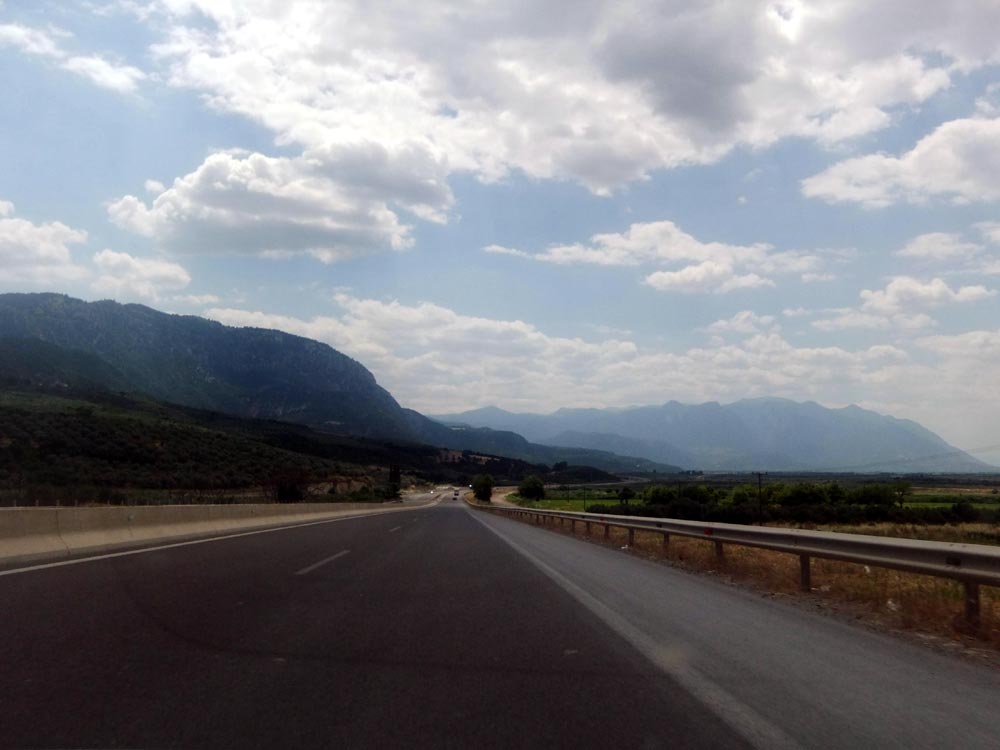
Thermopylae is a place where you really shouldn't visit unless you're desperate or passing by. If you happen to be driving north from south-eastern Greece you'll go right by it and it is worth a look. Unfortunately there isn't that much there to see.
In Greek Thermopylae means the "Hot Gates." Thermopylae is famous for being the last stand of Leonidas and his 300 Spartans (and a few thousand others {including their slaves}, but we don't count them because it sounds cooler this way). Anyone who's been living on the planet Earth for the last few years is probably at least aware of the movie 300. Far be it from me to impugn the dedication to accuracy of a Hollywood movie but they did get one or two minor things wrong. This place will look strange to anyone who's seen the movie. It really isn't clear why anyone would defend this spot given the current topology of the ground.

Sunday, June 26, 2011

Arachova

Arachova is a wonderful place. It's a beautiful town built on the side of a mountain.Anyone going to Delphi from Athens will come right past here. If you get the chance it's definitely worth a stop. The entire town has the feel of a classy ski resort (which it is during the winter). It feels old, but not ancient. A sturdy medieval town. Really, it doesn't get much nicer than this. Places like this are the reason why northern Greece is so much nicer than the Peloponnese.