Showing posts with label Europe. Show all posts
Showing posts with label Europe. Show all posts
Friday, April 19, 2013

Saturday, November 10, 2012
Lincoln (Roman)
I already have a page for Lincoln but since that time I only dealt with the medieval sections (ie: the cathedral and castle) while this time I saw the Roman bits I felt that they could be safely divided in two. After all, that trip was almost two years ago.
Wednesday, September 19, 2012


Tuesday, September 18, 2012
Hadrian's Wall, Part VIII (South of the Wall)

Saturday, September 15, 2012

Friday, September 14, 2012

Thursday, September 13, 2012
Hadrian's Wall, Part III (Corbridge to Chesters)

Wednesday, September 12, 2012
Hadrian's Wall, Part II (Newcastle to Corbridge)

Having spent our first day wandering around Newcastle and getting the train everywhere we finally set off on the actual hike. Our plan today was to get to Corbridge where we had a bed & breakfast reserved for the night. I looked it up on Google Maps and it said that the entire journey would cover about fifteen miles, a long but not impossible stretch. Since there was basically nothing to see for this part of the journey (and certainly no stretches of wall) this didn't seem like a bad idea at the time. Do the serious walking on the days when there were few places to stop at and save the slow days for areas where there was a lot to see. There were only two problems. First, the distance calculation was based on road miles in a direct line to our destination. Google Maps doesn't include walking paths in its directions. I figured that the actual distance would be less than the road miles since the path could cut corners which roads would have to circle around. Boy was I wrong. The trail heads along the river for a while, but then it goes sharply north up through Heddon and then keeps going along a north-westerly direction whereas Corbridge is right on the river about two miles south of the wall. So our strenuous fifteen mile hike turned into a draining twenty mile slog that took up the entirety of the day. Second, I didn't factor in the terrain. Google Maps doesn't show the terrain and while Google Earth does it's very hard to get an idea from it of just how steep it really is. The hills weren't too bad (at least today) but once the trail goes off road all time calculations get thrown off. I'm used to hiking wilderness trails or along roads, not cutting across fields and climbing over fences. Progress is slow and painful, and it doesn't help when you're tired from having walked ten miles already and then up a steep hill. By the time we arrived at Corbridge at about 9 PM we were too tired to move.
Tuesday, September 11, 2012
Hadrian's Wall, Part I (South Shields to Newcastle)

Monkwearmouth/Jarrow

Despite being grouped together the twin monasteries of Monkwearmouth and Jarrow are actually about seven miles apart. Their connection was a very real one though since they were both founded by the same man and were both home to that most famous of Saxon scholars: Bede. Bede was that rarest of people in the Dark Ages, a well-educated polymath. He not only wrote the sole contemporary history (as opposed to chronicle) of Anglo-Saxon times, he also wrote tracts on astronomy and mathematics as well as chronology. His use of Anno Domini (AD) was so successful that it overrode all other dating systems to become the one used until this day. I will say more about Bede later since there is a museum dedicated to him in Jarrow. In fact, the metro station closest to Jarrow Abbey is called Bede. Despite being grouped together there are three separate places here: Wearmouth Abbey, Jarrow Abbey, and the museum known as Bede's World which features a reconstructed Saxon village.
Wednesday, June 29, 2011
Tuesday, June 28, 2011
Philippi
Philippi is famous not as a town but as the site of the final battle between Octavian and Anthony on one side, and Brutus and Cassius on the other. It was here that the fate of the Republic was decided. This was a major battle with around 100,000 men on either side. The battle was actually two battles fought on the same plain several days apart. On the first day Marc Antony took Cassius' camp while Brutus took Octavian's, but due to the confusion of battle Cassius thought that all was lost and killed himself leaving Brutus to lead the troops in the next confrontation. He wasn't up to it. Apparently the Liberators were in front of the town while the Caesarean forces formed up further out. It would be really difficult to overstate the importance of these battles. Because of this the Republican cause died for good. Cicero was already murdered, Cato had killed himself a few years before, and now Cassius and Brutus joined him. The only major figure left for the Republicans to form up with was Sextus Pompeius. At this point Antony and Octavian were the unquestioned masters of Rome.
Brutus: Why comest thou?
Ghost: To tell thee thou shalt see me at Philippi.
 At Philippi our luck ran out. These guys intended to honor the strike and they were manning the place to make sure that nobody snuck in anyway. But although we may not have gotten to go into the site we could still see most of it from the roads.Still unfortunate given that its two hours east of Thessaloniki.
Brutus: Why comest thou?
Ghost: To tell thee thou shalt see me at Philippi.

Pella
This day was an odd one. After the riots in Athens the entire country went on strike. All government-run sites shut down so the tourist sites were closed. Or at least they would be if this hadn't been Greece. Heaven forbid the Greeks should be consistent. Finding out that these sites would be inconsistently open we decided to try for them. So our first stop was Pella which was about 40 minutes out from Thessaloniki.
 Pella was the home of Alexander the Great. From this place Macedonian troops went out to conquer Greece and Persia. Built up under Alexander's father Philip this city became the capital of Macedonia during the 4th Century BC. After Alexander and his immediate successors died the city became less important until it was dwarfed by Thessaloniki after Pella was damaged in an earthquake and the inlets dried up.

Monday, June 27, 2011
Thessalonika

Iolkos

Thermopylae
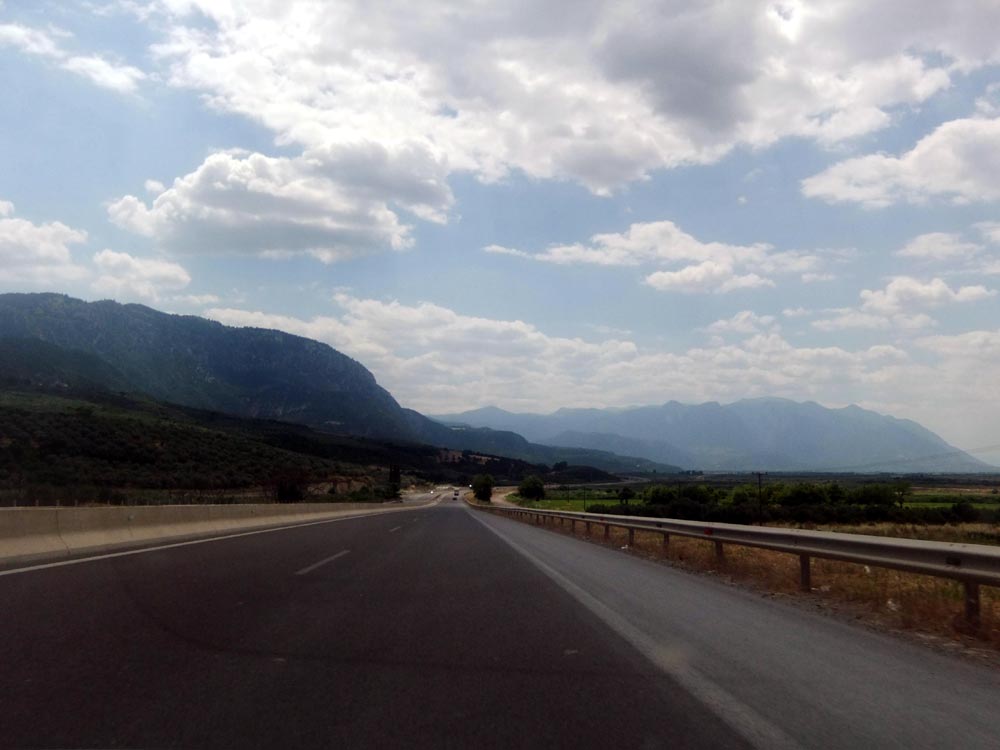
Thermopylae is a place where you really shouldn't visit unless you're desperate or passing by. If you happen to be driving north from south-eastern Greece you'll go right by it and it is worth a look. Unfortunately there isn't that much there to see.
 In Greek Thermopylae means the "Hot Gates." Thermopylae is famous for being the last stand of Leonidas and his 300 Spartans (and a few thousand others {including their slaves}, but we don't count them because it sounds cooler this way). Anyone who's been living on the planet Earth for the last few years is probably at least aware of the movie 300. Far be it from me to impugn the dedication to accuracy of a Hollywood movie but they did get one or two minor things wrong. This place will look strange to anyone who's seen the movie. It really isn't clear why anyone would defend this spot given the current topology of the ground.
Sunday, June 26, 2011
Arachova

Chaeronia

Thebes

Subscribe to:
Posts (Atom)